Showing posts with label Michael Harshaw. Show all posts

Sunday, April 5, 2015

Michael Harshaw 1807 -1876 Life in America

The Harshaw family from a small rural farm in Ireland began the hard work of creating a new life in rural Pennsylvania. In the few years after the reunion of the family, they were able to acquire for the first time good land which they actually owned. By the time the 1830 census was taken, the family was settled in West Salem Township, Mercer County, with Sarah buying the farm there just 3 years later.

Michael however wasn't listed with the rest of the family. He had moved on to fulfill his lifelong dream to acquire an education. He was living in Jamestown Pennsylvania, attending the Gamble Academic Institution. It must have been very difficult for a man already in his 20s to be attending classes with students much younger than he. Classes cost $4 a quarter. He had to work to earn the money for his educationm and support himself while he was studying.

Sometime in the 1830s, Michael completed his studies in Jamestown. By that time, there was a new university in Pittsburgh. He applied and was accepted. Pittsburgh was a growing industrial hub with smokestacks hurling black dust into the air, making breathing difficult, and layering black dust over all surfaces. It was a far cry from the lovely green valleys of Ireland. But there he could find work and continue his education. He was able to get a job at a local rock quarry where he could support himself while he studied. The owner allowed him to fit his work schedule to his college one, as he had become a trained blaster working on the Erie Canal. He blasted rock and then removed it in wheelbarrows for use in the building of the new city.

The Western University building was located in a section of the town where a number of Irish immigrants lived. Michael came to know a young seamstress who had immigrated to America with her mother from County Antrim in Ireland, Margaret McCloskey. The two Irish newcomers certainly shared their fond memories of their home country and in the process fell in love.

The young couple was in no position to marry for a long time. Michael did well in college, and decided that he wanted to study for the ministry. When he completed his college education, he was taken as a student by the Rev. John Black. By the time Michael was ordained in 1838, he could read the Bible in both Greek and Hebrew.
Rev. John Black 
1768-1849


Despite the large number of Irish immigrants, there weren't enough churches for Michael to have a settled parish. Instead the Presbytery of Western Pennsylvania offered him a position as itinerant preacher. Members of the Covenanter Church in Pittsburgh raised the money to buy him a good gray horse, with saddle and saddlebags, ready to take Michael into the wilderness.


Itinerant Preacher


First he rode west through Ohio and Indiana, before turning south.   His territory would be through the southern states west of the Alleghenies. For several years Michael traveled the small back roads of Kentucky and Tennessee, riding as far south as Alabama. He would stay for a few weeks in small towns and then move on.

There was considerable personal risk involved for any man on a nice horse to be riding alone in wilderness areas. One night, he came upon a new cabin in a very remote area. He dismounted and knocked on the door. A rather fearsome looking woman responded, and seemed most reluctant to admit the stranger. When the husband returned from work, Michael was even more concerned. The husband more resembled an outlaw that hard working farmer.

Still the couple invited Michael to share their supper of mush and milk. When they had eaten, the man began to fumble in his pocket. Michael feared that he was reaching for a knife. But instead he pulled our a Bible from his pocket and asked Michael to read for them.  Michael was only too happy to oblige.

Finally Michael rode north and crossed the Ohio River in southern Illinois. A few miles north there was a new settlement of families that had moved out of Abbeyville, South Carolina to avoid slavery. Michael may well have known about this settlement, as they were Irish families that had been part of the emigration from Ireland led by Rev. William Martin. Rev. Martin was the first minister of the Covenanter Church in Kellswater, Country Antrim, which was the church attended by the woman Michael intended to marry.

There was already a Reformed Presbyterian Church in Eden Il. But these Irish immigrants had come from the more conservative branch of the religion. And so did Michael. This flat land was nothing like the rolling hills of Michael's native Armagh, but the land was rich and easy to farm. Eden was already a growing community, so Michael would live in an area with many more amenities that many of the others he had visited in his travels. And there was no slavery, something Michael and his fellow Irish considered evil.

Michael took a good look around the area while he ministered to these farmers. Apparently, they found Michael's preaching and religious principles to their liking, as they issued a call for him to become the minister of the church they intended to build. Michael accepted the call and returned to Pittsburgh to prepare for his new life in Illinois.

The first thing Michael did was to propose to  the young Irish girl he had met while he was attending college there. The ceremony took place on Dec. 27, 1842. Finally, at the age of 35, Michael had achieved the place in life that he could only dream of in Ireland.
Michael and Margaret circa 1850


The young couple packed up their few possessions, loaded them on a barge and let the current of the Ohio River bring them to their destination. There was much to be done when Michael and Margaret arrived in Eden Illinois. Members of the congregation helped acquire 150 acres, the first plot of land Michael had ever owned,  Michael build a log cabin in what would become Cutler, Illinois. Then he and his congregation set about building a simple church in which to worship. They built the church in a lovely grove of trees on the highest point of land in the area. They called it the Mound Church.

For all of his life, Michael was a farmer as well as a minister. He would work through the week just as his neighbors did, with the added responsibility to minister to the sick and dying. As he worked, he certainly thought about what he would say to his congregation on Sunday. Covenanters dedicated the entire Sabbath to church lessons and sermons. They would come in the morning in their wagons, When the morning service was concluded, they would eat the lunches they had prepared the day before and brought with them. After they had eaten, afternoon services would begin.

This new life must have seemed the culmination of an impossible dream to Michael. He owned land, had a congregation of his own, a home, however humble, and a new wife. After 36 years of endless work and study. Michael had reached his goals, and could look forward to a life of achievement, happiness and service.

Michael Harshaw > William Roseborough Harshaw > Harold McCloskey Harshaw > Marjorie Harshaw (Robie)

to be continued )


Monday, March 23, 2015

Michael Harshaw 1807 -1876

Ireland was home for Michael for the first 17 years of his life.
Baptism Record for Michael
County Down Near Harshaw Farm?
He was born in the townland of Ballydogherty, Loughgilly Parish, County Armagh, the son of Andrew Harshaw and Sarah Henry. When he was born in 1807, he had 4 older brothers, Andrew, Joseph, Henry, and David. The family lived in a small house several hundred yards down a long lane from Ballydogherty Road.
Possible Harshaw House, Ballydogherty Road

Life was good for this red haired Irish boy for the first years of his life. English rule had been made less difficult for Irish citizens by English need for Irish farm produce. After years of war with France, Irish farm prices, and rents rose sharply. Finally farmers like Andrew had some extra money that allowed them to indulge in such luxuries as a table and chairs, more beds for the children.

Two more children had joined the Harshaw family, William and Sarahm before the war ended in 1815. Hard times had begun for Michael and his family two years earlier when Andrew died.  He was buried in the Presbyterian Church at Tyrone's Ditches, which he had helped found.

The older boys were expected to manage the farm work. Though Michael was only 6 years old when his father died, he was expected to carry an increasing workload as he grew older. Economic necessity made Michael's great yearning for an education,, an impossible dream.

The family managed to cope with the hardships of Andrew's loss. But when the English war ended in 1815, a terrible depression hit Ireland. Crop prices fell, but rents remained at wartime levels. Twice a year, in May and November, all lease holders like the Harshaws, had to appear before the land owner or his agent to pay the rent. Often families like the Harshaws went hungry in order to save enough to pay the rent.

All across Ulster, families began to auction off their leases to get enough money to travel to Canada or the United States. When word came back to Ireland that they had found land in the remote parts of the county, more families joined their friends and families in America. The Harshaws of Loughgilly were one of those who reluctantly made the decision to leave Ireland.

But first, they had to have enough money to pay for passage. Apparently, the Harshaws sold a pig to get ticket money. By this time in 1824, Michael had become a very strong young man. The family decided that he could find a job that would pay enough to help bring the rest of the family to America. But rather than travel alone, it was decided that his older brotherAndrew would go with him.

Usually such partings were permanent. But when Michael set out down the lane with a small satchel and a blanket, he had hopes that he might see his family again in America. They were depending on him to earn enough money to make sure that this reunion took place.

Michael and Andrew walked through Newry and on toward Warrenpoint where the ship was waiting to depart on the first proper tide. He tried to memorize Ireland as he walked, for he knew he would never see the land he loved again.

Warrenpoint was the shipping center for the area. It was possible to travel directly to Canada from there.  The last view of home for Michael was of the mountains of Mourne and Carlingford,
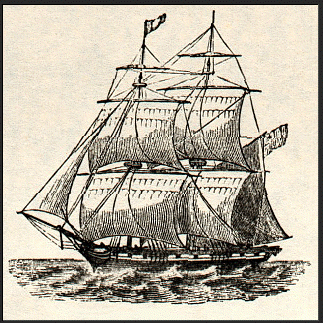
as the brig sailed down the lough toward the Irish Sea.
Carlingford Lough


Brig


The passage to Canada was a stormy and long one. Michael was grateful for the extra bag of oatmeal his mother had packed in his bag. So when he first saw land birds and knew that land was near, he was very glad. As the ship sailed down the St. Lawrence River, Michael could compare the land of Canada with the land of home. He first set foot in his new land in the city of Quebec. The city was cramped into a narrow strip of land between the river and the cliffs.

Smaller steamers sailed up and down the river every day between Montreal and Quebec. Michael and Andrew quickly boarded one for the next stage of their trip. They needed to get to their destination before they had no money left. From Montreal, they set out by boat and on foot to reach Lewiston, near Buffalo. There they hoped to find work on the Erie Canal.

Many Irish immigrants had been working for several years to build this canal across the state of New York. The last segment was under construction, In order to raise the boats to the level of Lake Erie, a series of locks were being constructed over the Niagara Escarpment.
Both Harshaws were immediately hired for this challenging project. Men working on the canal signed contracts to work for 80 cents a day, plus all the whiskey they could drink. This was twice the average wage paid at that time.

Michael didn't drink, so this part of his pay was of no use to him. Living conditions were harsh. The men were fed substantial meals, but they lived in wooden sheds that moved with the workers as the canal building progressed. Each man slept of a bare plank of a double decker bed. There was no glass in the windows to protect them from the winter which was colder than any Michael had ever known, or screens to keep out the insects of summer. Still Michael was pleased to have work that would enable him to bring his family to America soon.

His fellow workers enjoyed consuming their whiskey in the evening. But Michael did not drink, and his sober presence made them uncomfortable. So a group of the Irish workers decided to force Michael to join them in their drunken rowdiness. Michael saw the group coming for him, and figured out what they intended. Michael stood almost 6 feet tall, and was strong from years of hard work. He didn't intend to go down without a fight. The leader of the group was a small and stocky Scotsman. Michael walked out to meet the mob. He grabbed the leader by the back of the neck and the seat of his pants, raised him over his head and dropped him to the ground behind him.

Michael's actions knocked the wind out of the leader and his followers as well. They retreated and left Michael alone in his sobriety. This action caught the attention of the supervisors. His whiskey allowance was converted to cash. Michael found himself making the grand wage of $1 a day. Perhaps this was also the reason why Michael was entrusted with the dangerous work of blasting the rock wall to make the lock construction possible. Such dangerous work would command extra money. Michael was undoubtedly pleased to be making such high wages, and viewed the danger as worth the risk.

The Erie Canal opened in the fall of 1825. It was time for the rest of the family to come to America. When they safely arrived, the reunited family left New York and headed to Western Pennsylvania where Michael's uncle William and family already had acquired their own land. Now, it was the hope of Michael's family that they would be able to create a farm of their own too.

Michael Harshaw > William Roseborough Harshaw > Harold McCloskey Harshaw > Marjorie Harshaw (Robie)

(To be continued.)